
Areas of Expertise
Services and Solutions
Context
The current funding landscape for early childhood care and education (ECCE) in Louisiana is fragmented and insufficient to meet families’ needs. Providers struggle with varied and inconsistent funding sources, preventing them from sufficiently investing in their programs and their workforce. Seats are unevenly distributed around the state, limiting families’ access. Care for infants and toddlers is particularly limited; while Louisiana’s preschool program serves 92% of in-need four-year-olds, only 5% of in-need infants and 13% of in-need one-year-olds are served with public funding.
However, Louisiana has a unique tool to address these challenges: the ECE Fund, a state fund that matches local contributions dollar-for-dollar to expand access to early childhood care and education for children from birth to age three. Parishes can raise money through taxes, philanthropy, local budgets, or any other means, and double their investment with state support.
Even with this local investment, the early childhood field still struggled to plan based on unpredictable state funding each year. In 2023, the Louisiana Legislature passed Act 83, which expanded the charge of the Early Childhood Care and Education (ECCE) Commission to include development of “a formula that could be used on an annual basis to determine the funding necessary to sustain and grow the early childhood education (ECE) system and any necessary legal changes needed to implement such a formula.”
Afton partnered with the Louisiana Policy Institute for Children, a leading policy and advocacy organization, to support the process of developing this formula.
Goal
Louisiana policy makers wanted to be ready to launch a formula for early childhood funding if and when the opportunity arose. At the same time, they were looking for short-term wins: ways to communicate about the need and to show tangible progress.
Our work together was designed to answer several related questions:
- Where is early childhood funding going now? Which parishes and age groups are well-served, and which have the greatest need?
- If we want to expand the number of children served in a particular parish or age group, what would be the cost?
- What is needed to build toward a sustainable and predictable formula-based approach to early childhood funding over time?
Approach
Follow the Money
From the perspective of state legislators, Louisiana spends a lot of money on early childhood. There’s the state pre-k program, the Child Care Assistance Program (CCAP), the ECE Fund that matches local dollars, and more. But where does all that money go, and does it come together to meet the need?
To answer these questions, we started by mapping data on slots and funding to each parish by age group and program, giving a granular geographic view of where children were being served and with how much public money. We found that funding was positively correlated with need (i.e., higher-poverty parishes did receive more funding per child, on average), but there was still wide variation in funding across the state.
Using this foundation, we built a statewide funding model that allowed the state to model different scenarios. For example:
- What if the percentage of infants served increased by 10%?
- What if payment rates more closely matched the cost of care?
- What if children with disabilities or developmental delays received more funding to reflect their greater need?
The model also considered where the money would come from, offering options for greater contributions from local dollars and even employers.
Responding to Leaders on the Ground

When we showed this model to local leaders, they thought it was great – but overwhelming. They wanted to know what this meant for their community. How are we doing with our infants? What would it cost to reach more of them?
One community had a new data center opening soon, drawing more families into the area that would need care. How many more slots were they likely to need, and what funding would be required to support them?
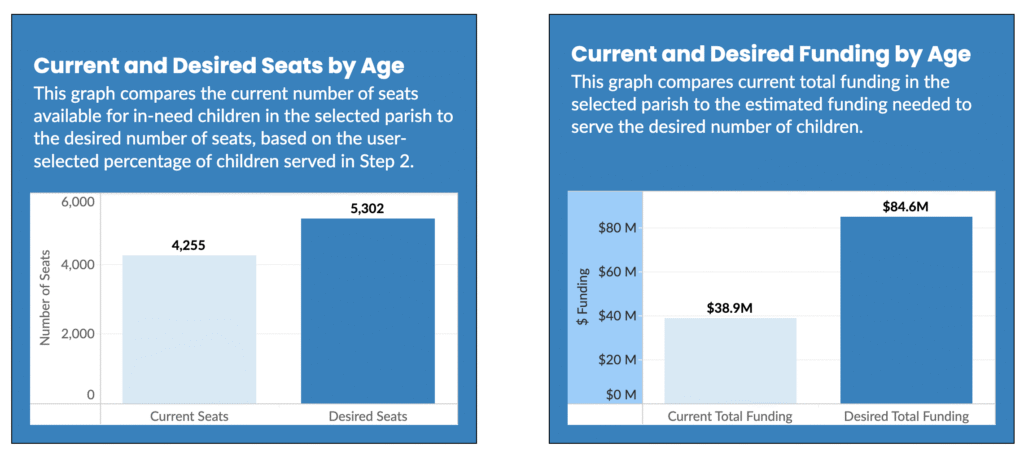
Responding to their feedback, we built a new version of the model that looked at one parish at a time. It pulled in current numbers on children served and funding, and allowed the local leaders to try out different scenarios.
With this version, local leaders could engage with the specifics. They asked insightful questions about the data and made suggestions about the questions they most wanted to understand.
Thinking Long-Term at the State Level

At the same time that we analyzed the data and built tools to support short-term needs, we kept our eyes on the long term goal. Over the course of two years, we facilitated seven meetings of a statewide task force to think through a formula for early childhood funding, like the one that the K-12 system uses. We discussed questions like:
- What sources of funding should be included in a formula? What should stay separate?
- How should funding be weighted for children’s specific needs, such as disabilities?
- How should the funding reach providers?
- How should the formula account for competitive compensation for the workforce?
Task force members thought creatively and drew from their knowledge of other systems, including K-12 and higher education, to envision how funding could be more coherent and stable.
Outcomes
Louisiana Parish ECE Funding Dashboard
The local leaders we worked with were excited about the Excel model we had built for their parishes – but they didn’t want to stop there. They wanted this tool to be accessible to everyone. They imagined meeting with a local business leader and pulling it up to look together at different possibilities for their community, or using it to create their own materials showing the need for additional early childhood funding.
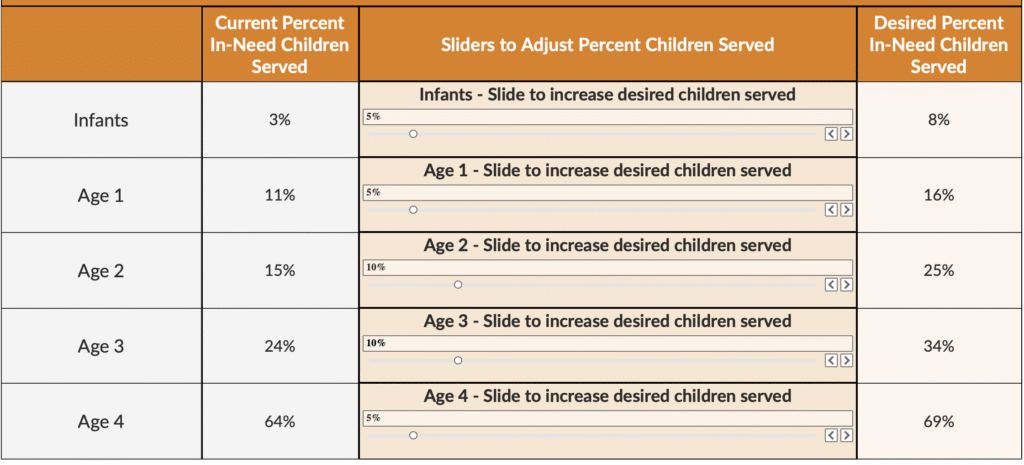
In response to their requests, we built the Louisiana Parish ECE Funding Dashboard. The dashboard now lives on LPIC’s website, so that anyone in Louisiana can use it to plan for and learn about their local needs.
Funding Design Recommendations
After the first year of task force meetings, we produced a set of high-level set of recommendations addressing how to gradually expand access, build a formula around the cost of care for different age groups that meets high quality standards, and build on existing funding sources and structures. Our team continues to work with LPIC and partners across Louisiana to plan for how to operationalize these recommendations over time.
Takeaways
Define your “north star,” but don’t stop there. Even as leaders in Louisiana have a vision for the early childhood system they want to create, they understand that progress toward this long-term goal can be uneven and unpredictable. In the short term, every local community that makes a new investment in its youngest children builds buy-in, generates momentum, and helps families access the care they need. The work we are doing toward the long-term goal also supports short-term wins.
Data is power. The Funding Dashboard empowers local leaders to tell their own stories about the need in their community and how they can tackle it. By making wonky data more user-friendly and accessible, we were able to multiply its impact.
Answers come from communities. At Afton, we believe solutions exist in the communities being served, and our job is to listen, support, and lift up those ideas. Local leaders who are closest to the challenges on the ground guided our process with their input, feedback, and ideas, making the work stronger and more meaningful.


