
Areas of Expertise
Services and Solutions
Context
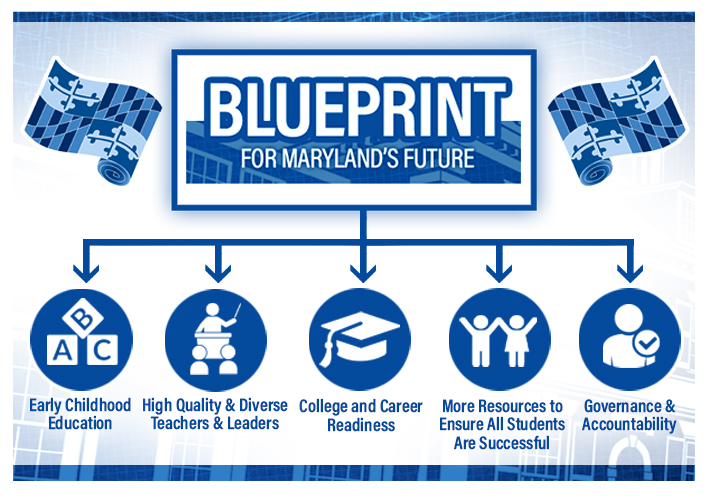
In 2021, Maryland passed the “Blueprint for Maryland’s Future,” one of the most ambitious education reform laws in the country. It’s a 12-year initiative spanning five pillars with significant investment and sweeping policy changes across all 24 county-level school districts.
Maryland’s 24 LEAs range from Montgomery County (one of the largest school systems in the country) to Kent County, which operates five schools across a vast rural area. The same policy applies to all of them. But their capacity to execute varies enormously.
To ensure the Blueprint stays on track, the state’s legislature established its own Accountability and Implementation Board (AIB). The AIB needed a partner who could hold both perspectives: advise at the state level while understanding what districts actually experience on the ground. Afton played both roles.
Goal
Afton was engaged for 18 months (July 2024 – December 2025) to serve two distinct functions within the Blueprint’s Pillar 5: Governance and Accountability.
First, as Strategic Lead at the state level: Afton convened and guided a community of practice (CoP) among parallel organizations focused on resource allocation, surfacing implementation challenges, and advising AIB on LEA’s experience.
Second, as Strategic Partner to four county-level LEAs. We worked closely with the school systems of Kent, Dorchester, Calvert, and Worcester counties to provide direct technical assistance to help them meet state requirements within their local contexts.
Across both work streams, we held the question, “How might we translate state-level policy into local-level practice when the contexts can be very different?”
Approach
Wearing “two hats” in this engagement was practical and intentional. State policymakers understand the law. Districts understand what it takes to execute. The gap between policy and practice is where implementation breaks down. As Afton’s Partner Katie Reed puts it: “Implementation is where people experience policy.” Holding both roles let us translate in both directions.

State-Level Strategic Leadership with a Community of Practice
We led a monthly community of practice among the orgs providing technical assistance across Maryland’s 24 LEAs (e.g., channel partners, peer organizations, and other firms working on Blueprint implementation). Our role was to facilitate problem-solving, surface patterns, and advise AIB on how to best support the state’s LEAs.
State staff are legal and policy experts. They aren’t necessarily experts in expenditure reporting or resource allocation mechanics. They don’t always know what they don’t know about implementation. Afton brought that lens.
When districts hit edge cases (e.g., a teacher whose time spans multiple programs, a small school that can’t meet staffing ratios, a budget line outside standard categories), we helped drive towards solutions that honored policy intent without creating unworkable burdens. Patterns that seemed isolated often turned out to be systemic. That visibility made our state-level advising more grounded.
Direct Technical Assistance to Four LEAs
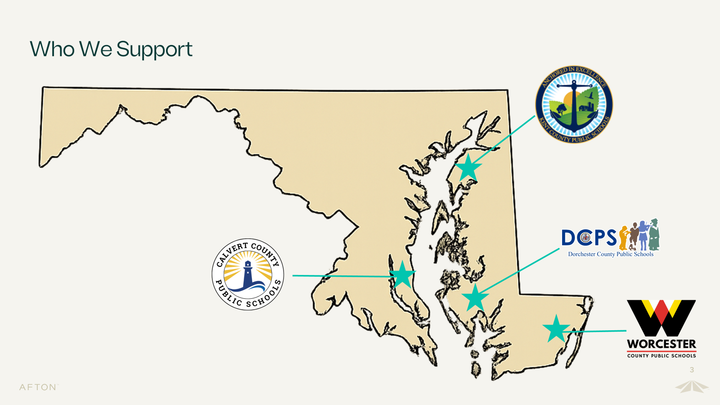
Afton partnered directly with the school systems of Kent, Dorchester, Calvert, and Worcester counties, partnering with each to tailor district-specific project plans according to their needs, but centering all on the focus of meeting the Blueprint’s Minimum School Funding (MSF) requirement.
Kent and Dorchester opted for foundational work with their budget process development. We built budget processes, delivered MSF training, and provided fiscal planning support. Calvert and Worcester opted for more technical modeling: financial models, resource allocation options, and decision support.
The MSF policy requires districts to tag expenditures (e.g., salaries, benefits, supplies) to specific state funding streams. This had never been done at this scale in Maryland. We helped districts build systems, develop protocols, and resolve ambiguities case by case.
Pairing similar districts allowed learning to transfer. In the final six months, we brought all four together as a cohort community of practice covering MSF implementation, AIB progress monitoring preparation, principal involvement in budgeting, and stakeholder engagement.
We also showed up in person throughout the summer with road trips to each LEA for on-site training sessions. Being in-person with folks built trust and gave us clearer insight into what each district was navigating, including the operational nuances that smaller counties with leaner staff experience across wider geographies.
Outcomes
After 18 months, the LEAs walked away with stronger budget processes, clearer systems for MSF implementation, and experience navigating state accountability requirements. The cohort model built peer relationships that will outlast Afton’s engagement.
At the state level, the AIB gained a partner who could translate district-level challenges into policy-relevant insights. When implementation surfaced ambiguities, we helped develop solutions that kept the Blueprint on track without creating unworkable burdens for smaller districts.
The work is not finished. The Blueprint is a 12-year initiative and Afton’s work engaged the Blueprint over 18 months. Some districts are further along than others. But the foundation is set for continued progress.
Takeaways for State Leaders
State-level reform requires more than good policy. It requires implementation infrastructure: technical assistance, peer learning, and the capacity to translate between state requirements and district realities.
Legal expertise gets you the law. Implementation expertise gets you results.


