

Preschool-age children with developmental delays and disabilities are often served in segregated preschool classrooms, despite federal mandates and guidance. This article presents a way forward for states to move the needle in increasing preschool inclusion, including:
- Strategic use of preschool inclusion data
- Adoption the National Indicators of High‑Quality Inclusion
- Implementation of clear policies and fiscal strategies
The Current State of Preschool Inclusion
According to the U.S. Office of Special Education Programs, only 43% of preschool‑age children with disabilities are served in inclusive early care and education (ECE) settings. That means three out of five preschoolers with disabilities receive their special education and related services in a segregated setting. This is despite the Individuals with Disabilities Education Act (IDEA) requirement that children with disabilities be served in the Least Restrictive Environment (LRE). Additionally, decades of research shows that inclusive early education positively impacts academic, developmental, and social-emotional outcomes for both children with and without disabilities.
To address the longstanding low levels of preschool inclusion for children with disabilities, the U.S. Departments of Education and Health and Human Services released the Policy Statement on Inclusion of Children with Disabilities in Early Childhood Programs in 2023. The statement emphasizes that school districts need to partner with community‑based early childhood programs (e.g., Head Start, child care, and private or public Pre‑K programs) to deliver services in the settings children already attend. This statement also clarifies that when a child with a disability is already enrolled in a public early childhood program (including publicly funded community‑based ECE programs), that setting must be the first placement option considered, even if the district operates its own inclusive preschool program.
Despite the federal regulations and guidance regarding inclusion of young children with disabilities in regular ECE settings, districts often still resort to providing services in segregated classroom settings and resist providing itinerant special education and related services to children with an Individualized Education Program (IEP) in community-based ECE settings, citing costs, lack of personnel, or misunderstandings that FAPE (Free Appropriate Public Education) cannot be met in these settings.
This article charts a path forward for states to increase preschool inclusion through use of data and accountability, strategic implementation of indicators of high-quality inclusion at the state and district/community levels, and policy and funding changes.
Using Data to Drive Change
Using data to drive change starts with understanding the state’s performance on preschool inclusion and how its percentage compares to other states.
These data are available from:
- IDEA Part B 618 Data Child Count & Educational Environments tables for the 2023-24 school year [Note: no data was available for NM for this year].
- State’s Annual Performance Report (APR) submissions, which include Indicator #6 Preschool Environments, measure the percent of children with IEPs ages 3–5 “attending a regular early childhood program [a program that includes a majority (at least 50 percent) of nondisabled children] and receiving the majority of special education and related services in the regular early childhood program”.
The map below shows the wide variation in the percentage of children served in inclusive early childhood education settings across states and territories with five states serving less than 20% of preschool children with disabilities in inclusive settings and another twenty states serving less than 40%.
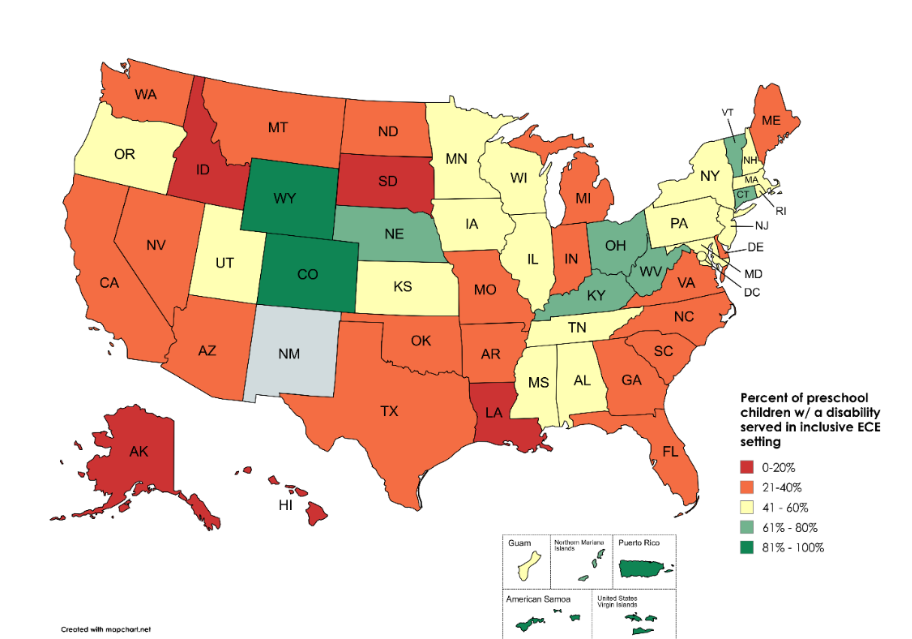
Here is a table showing preschool inclusion percentages for all states and territories.
States can strategically use data to drive change in preschool inclusion, through:
- Setting rigorous annual targets in their State Performance Plan (SPP) for APR indicator #6 for the percentage of preschool children they want to be serving in inclusive settings over the coming year. The national data showing where their state performance compares to other states can be reviewed with their IDEA state advisory panel to make the case for setting rigorous annual targets that will lead to change, rather than setting very minimal year-over-year targets.
- Developing data visualizations (dashboards and maps) of district-level inclusion that clearly shows the current state of preschool inclusion. This can enable the state leaders, school districts and community ECE leaders to compare preschool inclusion performance across communities, spotlight strong examples, and identify inequities.
- Having districts set rigorous preschool inclusion (indicator #6) targets. While there is no requirement under IDEA for Local Education Agencies (LEAs) / school districts to set APR indicator targets, this can be included as part of a state’s general supervision and accountability system. States should monitor district progress towards meeting their preschool inclusion targets and publicly report each district’s annual performance and whether they met their target. There is currently no data regarding which states require districts to set APR targets. States should prioritize districts that have low performance on indicator #6 to receive additional technical assistance.
- Encouraging districts to analyze their preschool inclusion data to plan how they will increase preschool inclusion. Districts can analyze and create data visualizations regarding the ECE settings (Head Start, child care, Pre-K, etc.) where preschool-age children with IEPs are served across the district, in order to strategically plan how to increase inclusion opportunities.
Implementation of the National Indicators of High-Quality Inclusion
One powerful systems strategy to promote inclusion across the mixed-delivery ECE system is for states to implement the national Indicators of High-Quality Inclusion.
These indicators were developed by the Early Childhood Technical Assistance (ECTA) Center and the National Center for Pyramid Model Innovations (NCPMI) along with partner organizations from across the ECE system. They include aligned strategies across four levels:
- State Indicators
- Community Indicators
- Local Program Indicators
- Early Care and Education Environment Indicators
Together, these indicators help states and communities identify strengths, gaps, and opportunities to build coherent, aligned ECE systems that support inclusion.
One of the first steps of implementing the national Indicators of High-Quality Inclusion is to establish a cross‑sector State Inclusion Leadership Team. With technical assistance, Illinois established a 15-member state-level inclusion leadership team that guided the implementation of national indicators of high-quality inclusion and establishment of Community Inclusion Teams.
A state-level inclusion leadership team can be a subcommittee of an existing advisory body or a cross-sector team convened for this purpose.
The state inclusion leadership team can support meaningful change by:
- Analyzing statewide and district-level data
- Identifying strengths and challenges across the state
- Setting goals, expectations, and shared accountability
- Identifying fiscal conditions, policy enablers, and clear guidance to support inclusion at the district/community level
States should also consider establishing Community Inclusion Teams at the district/community level, that include district special education leaders, ECE leaders and parents. Community Inclusion Teams can develop action plans with goals and objectives that are aligned with the community-level Indicators of High Quality Inclusion. Illinois’ Community Inclusion Teams in three districts have led to progress in preschool inclusion, and overall, the state has increased the percentage of preschoolers served in inclusive settings year-over-year.
Policies and Guidance to Support Inclusion Across the Mixed-delivery ECE system.
Nationally, 23% of 3 and 4-year-olds are served in publicly funded prekindergarten (Pre-K) according to the State of Preschool 2024 Yearbook, with percentages varying across states. As states expand their publicly funded Pre-K programs, they have an opportunity to examine how they can increase access for children with disabilities to these inclusive preschool settings.
States should consider developing Pre-K policies that either prioritize or automatically make preschool children with an IEP eligible to receive a Pre-K slot across the mixed-delivery system. Twenty-five states report that a child with a disability or developmental delay is considered a “risk factor” that can be used to determine prekindergarten program eligibility. States like Oklahoma, Kentucky, and Colorado have policies that require that children with IEPs will automatically have their general education curriculum costs funded under the state-funded Prekindergarten (Pre-K) program.
States should develop funding policies and guidance that effectively supports preschool inclusion by districts, including the braiding of funding across the mixed-delivery ECE system.
States can also use cost modeling to examine the current fiscal structure for the provision of early childhood special education and related services, including opportunities for revenue enhancement through Medicaid billing. Cost modeling can also examine the costs associated with increased ratios and environmental modifications related to serving preschool children with disabilities in community-based ECE settings.
The Path Forward
Change isn’t easy, but there is clarity on how to move forward.
It takes intentional leadership, cross-sector partnerships, rigorous data use, clear policies and guidance, and appropriate resourcing – all in service of prioritizing young learners. When done well, states can build inclusive early childhood systems where young children with developmental delays and disabilities learn, play, and grow alongside their non-disabled peers.
The tools exist. The research is clear. The federal requirements are longstanding. What’s needed now is bold state action to ensure preschool inclusion for all children with developmental delays and disabilities.
Andy Gomm is a senior consultant with Afton Partners, where he guides systems consulting in early intervention (Part C), early childhood special education (Part B-619), home visiting, and Infant & Early Childhood Special Education. You can contact him at agomm@aftonpartners.com.
How We Can Help

Government Agency Strategy & Operations

Research & Analysis

Financial Planning & Analysis
Related Insights

Three Questions About the FSTC Every State Leader Should Be Working Through Right Now
