

CCDF State plans are coming! This is the second brief in a series focused on supporting states preparing their CCDF state plans. For more context, start with the first brief here.
What is Alternative Methodology?
One of the most important developments in early childhood finance in the last decade has one of the most confusing names: “Alternative Methodology.” Despite the enigmatic name, it’s having a big impact on child care payment rates across the country.
To understand what makes this approach an “alternative,” we have to go back to the way child care subsidies have historically been set.
The federal Child Care Development Block Grant (CCDBG), also called the Child Care Development Fund (CCDF), requires payment rates for subsidies to be benchmarked to the “market rate.” States do a Market Rate Survey every two years to learn what child care providers charge in private tuition. CCDF guidance calls for setting subsidy rates at the 75th percentile of the market rate, meaning that a family using a subsidy could access 75% of the private market. In practice, few states have historically reached this benchmark due to underfunding and the trade-off between higher rates and more children served.
The problems with this approach are well documented: child care providers often set their tuition according to what parents can afford to pay, not their true costs. The result is underpaid staff and providers operating on razor-thin margins. In other words, the Market Rate Survey measures the price of the child care service, but the price does not always cover the cost. This mismatch is even more severe in low-income areas, where families can afford even less in private tuition, leading to inequities in subsidy rates across neighborhoods.
In the 2014 reauthorization of CCDBG, Congress recognized this issue and allowed states to set their rates using an “alternative methodology, such as a cost estimation model” instead of the Market Rate Survey. Essentially, this meant setting rates based on cost rather than price.
In 2020-21, New Mexico and DC became the first in the country to use Alternative Methodology to set their child care subsidy rates. Other states, including Virginia, Colorado, and South Carolina, soon followed. Recognizing the momentum behind the idea, the federal Department of Health and Human Services (HHS) put out updated guidance on using Alternative Methodology in January 2025.
The HHS guidance requires states using Alternative Methodology to:
- Submit a request for pre-approval from HHS that includes their plan for field engagement, data collection, and cost modeling
- Collect data or use administrative data; data should be collected or updated within two years of submitting their state plan
- Validate this data with input from providers in the field
- Create a cost model or cost study using this updated data
- Translate that cost model or cost study into rates, describing how rates compare to the costs of care
Notably, the guidance does not require rates to cover the full cost of care. Many states are working toward this as a long-term goal, but are not yet able to reach it with current funding levels. (Full disclosure, I was part of a group of cost modelers who provided input on the guidance as subject matter experts back in 2023.)
States can request approval to use Alternative Methodology as part of their regular CCDF state plan cycle or at any time during the cycle. If they are approved, the Alternative Methodology approach replaces the Market Rate Survey, although some states choose to continue to collect information on private tuition to inform their understanding of the full child care market.
How is Alternative Methodology Different From a Narrow Cost Analysis?
Confusing things even further, in 2018, HHS began requiring all states to conduct a Narrow Cost Analysis as part of their CCDF state plans. Knowing that not every state would want to go through the Alternative Methodology process and develop a robust cost model, they still wanted to be sure that each state had at least a basic understanding of the cost of care.
Both the Narrow Cost Analysis and Alternative Methodology are ways of understanding the cost of providing child care and the difference between price and cost. They differ in their level of nuance and detail:
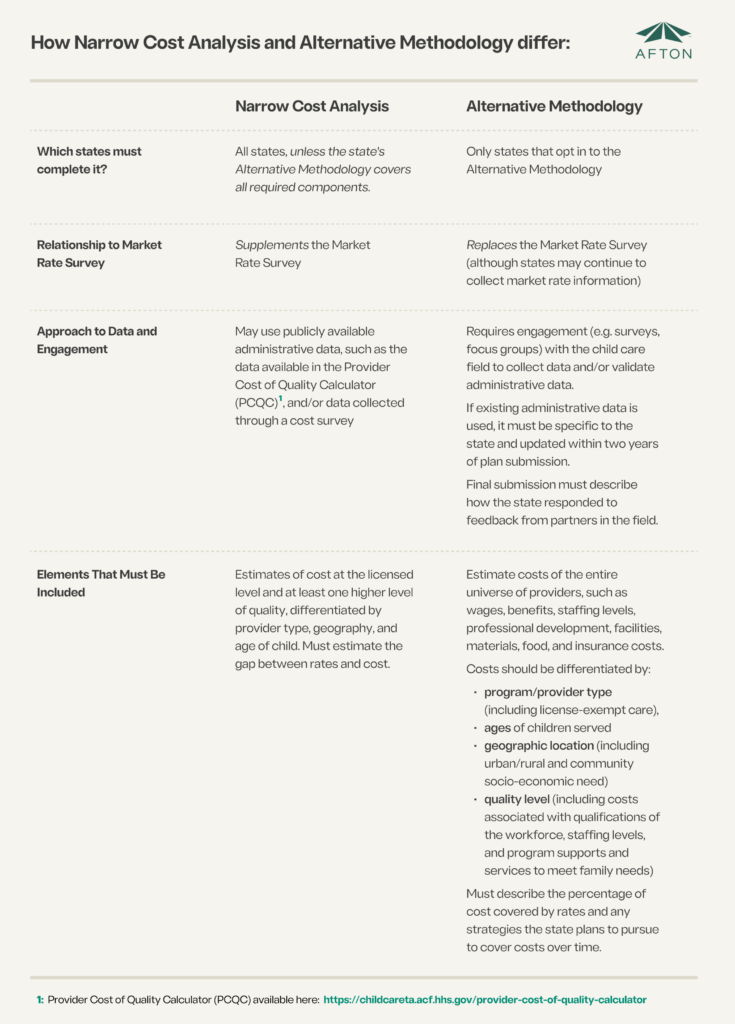
Two Possible Paths For Your State
While every state has to complete the basic federal requirements, if you’ve read this far, we can assume that you’re interested in doing more than just checking a box. We have seen states use two different paths to move their early childhood system toward deeper understanding of the cost of care and meaningful action to improve early childhood funding.
Path 1: Lean Into Your Narrow Cost Analysis
If you embrace its potential, a Narrow Cost Analysis can be a great vehicle for understanding the cost of care. It doesn’t require federal pre-approval or extensive documentation, and it can still result in a strong cost model that you can use to answer critical policy questions. The key here is to fully understand what data you have and what you need.
First, evaluate what publicly available or administrative data is available. For example, do providers already enter staffing and wage information into a workforce registry?
Next, use surveys to collect the most critical information that is not available or not reliable. To ease the burden on providers, surveys could prioritize the most important cost drivers (e.g. such as compensation, benefits, facilities, and food) and use public tools like the Provider Cost of Quality Calculator for the less significant costs. These questions can be combined with the required Market Rate Survey.
If possible, it’s also a good idea to use some focus groups to validate your assumptions with providers in the field.
The resulting cost analysis can include nuances around geographic regions, ages, settings, quality levels, and workforce compensation that go beyond the minimum requirements. As long as the Market Rate Survey remains part of the equation when setting rates, this doesn’t require pre-approval. This can be a flexible approach for states on their way to prioritizing meeting the costs of care.
The benefits of this approach include:
- Useful, robust cost information, particularly if the state has existing high-quality data and/or is willing to use surveys to collect it
- Fewer administrative hoops to jump through, with no required pre-approval
- More flexibility, including discretion about which data sources to use and how to engage the field
The major drawback is the lack of a clear signal about the state’s approach. Because the state is still conducting and using the Market Rate Survey, the field may not understand how cost estimates relate to their rates at the end of the day.
Path 2: Alternative Methodology
The Alternative Methodology approach will produce the most complete picture of actual costs and signal clearly where your state is headed. It is also a larger administrative lift: it requires federal pre-approval, documented field engagement, and detailed written methodology.
Like the Narrow Cost Analysis, Alternative Methodology can start with existing administrative data, but that data must be comprehensive and recent. Data collection should be thorough about filling in any gaps. Pursuing this approach means investing time and effort in educating providers about why it is important to share their cost data, supporting them to fill out the surveys, and listening to the field through focus groups or other qualitative engagement.
Benefits of Alternative Methodology include:
- Clear Messaging and Goals. This is a clear way for states to communicate their commitment to understanding the real costs of providing child care and working toward meeting that cost over time.
- Field Engagement. By educating and engaging the child care field about why they are pursuing this alternative route, states can build support and understanding for their approach.
- Nuanced and Updated Data: Because this approach requires detailed, recent data collection, it can support a more detailed cost model that can give states a deeper understanding of how costs differ across settings, communities, quality levels, and more. States with strong, detailed cost models can use them to evaluate many different kinds of funding policy proposals, not just subsidy rates.
The major drawback of the Alternative Methodology approach is its administrative lift. States that have done it describe at least a year of data collection, engagement, and model-building before rates are set.
There is no universally right answer.
It depends on your state’s funding situation, political climate, existing data, capacity, and appetite for the work. Helping you think through those trade-offs is what this series is designed to do.
The child care field has shifted rapidly in the last decade to understand and incorporate the cost of care into its subsidy rates and policies. Alternative Methodology, wonky as it may sound, has been a major driver of this change. States should make an informed decision about the path that is right for them.
Related Insights

Infant & Early Childhood Mental Health (IECMH) – Strategies for Building a Statewide System
