

CCDF State plans are coming. This is the third brief in a series focused on supporting states preparing their CCDF state plans. If you haven’t already read it, please read the first and second briefs.
Engaging Families and Providers
Whether a state is using a market rate survey or alternative methodology approach to set rates, the CCDF plan requires consultation with the field. This typically includes engaging the state’s advisory body on early childhood. It may also involve listening sessions, surveys, or focus groups with providers, families, child care resource and referral agencies, advocates, school districts, and local leadership.
Engaging the field well takes time, so planning the state’s engagement strategy will need to be one of the earliest decisions in preparing for the next CCDF state plan. The engagement strategy should match the state’s goals and should be designed to inform specific decisions.
Why take the time to conduct robust field engagement? Some of the major reasons are to:
Learn something new.
When we ask people to spend time in focus groups, listening sessions, or completing a survey, it should be because we cannot get the information in another way. This could be because of gaps in administrative data, because there is nuance and local context missing from what we already know, or because the state needs to learn more about the needs of its priority populations (such as families of children with disabilities, families working non-traditional hours, immigrant/refugee families, etc). If a state has already done robust engagement to understand the challenges in the field, they should build on that information rather than asking it again.
Build buy-in with the field.
Engagement is an opportunity to create shared ownership. People are more likely to understand and support initiatives that they feel they helped to develop, and that meaningfully reflect their input.
Prioritize tradeoffs.
A state may have twenty things they want to achieve in the next three years. How to choose what to do first? Engagement with the field can provide guidance on what should rise to the top. We often approach this by asking people to rank their top three priorities in a survey, or asking questions like, “If you could change one thing, what would it be?” Inviting people into trade-off decisions can be a powerful way to both get more actionable input, and to build support for where the decision ultimately lands.
Best Practices for Field Engagement
Providers and families are busy; their time is precious. When asking for their input, best practices include:
- Meeting people where they are, joining existing meetings, groups, and community spaces whenever possible.
- Building trust. Families and providers may be reluctant to share information if they fear it will be used punitively. It’s essential to be clear about the purpose of the information and how it will be used. Collaborating with trusted partners can open doors: professional associations can help reach providers; providers can make connections to the families they work with every day; community organizations can be a trusted voice with priority populations such as families experiencing homeless or immigrants and refugees.
- Using multiple modes and opportunities, such as daytime, weeknight, and virtual meetings. Make sure to build in time and budget for translating materials and interpreting meetings to ensure language access. Bringing together quantitative data (surveys, administrative data) and qualitative data (input from participants) provides the fullest picture.
- Consider compensation for people’s time, whether in the form of gift cards, stipends, or professional development credit. This shows that you value their input. (Be aware that advertising compensation online can attract sign-ups from people outside the state, so incorporate screening to be sure you are reaching your target audience.)
- Testing materials with trusted members of the target audience before going public, to ensure that the language is clear and the questions are ones they know how to answer. Parent and provider representatives on state advisory groups are often excellent testers.
- Match the format to the goals: Surveys are typically best for gathering detailed quantitative information. Focus groups or listening sessions are best for understanding context and gathering stories.
- Close the loop by sharing a summary of takeaways with participants. If possible, give participants a chance to validate that the takeaways accurately reflect their input, and invite them to help make sense of results. Engagement should be an ongoing dialogue, not a one-time event.
For more on best practices and Afton’s approach to engagement, see this case study of how we supported a state’s CCDF plan development to reflect the field’s needs.
Going from Input to Rates
Engagement with the field is critically important, but it’s not the end of the story.
We don’t expect families or providers to be experts on funding policy – so how can we ensure funding and finance policies reflect what they want and need? Especially when engaging with families, it can feel difficult to connect the dots between a general desire for more access, higher quality care, or support for their child’s needs into specific decisions about CCDF subsidy rates.
At Afton, we have developed a three-step process for going from family need to funding policy:
1. Listen to families – especially families who have the most difficulty getting what they need today.
Authentic engagement meets people where they are and starts with open-ended questions. We design engagement with a focus on those who have the greatest challenges in the current system, including home-based providers, families with a home language other than English, and families of children with disabilities.
2. Engage providers on what they need to meet families’ needs.
No one is closer to the realities of what it takes than the folks who work with families every day. We ask both about what they are currently doing, and what they would want to do with more resources. We ask them to get as specific as possible about the people and materials they need – for example, which developmental screenings they use, how many floaters they need to give their teachers enough release time for family communication and required meetings, and how much more they pay their bilingual staff.
3. Translate that input into cost factors and validate those assumptions.
From providers’ input, we can identify staffing or materials costs. We make our best interpretation, then check it with providers to be sure we are understanding them and making realistic assumptions. Ideally, we can collect data on these costs through a survey. If that is not feasible, we start by building in placeholders that can be updated in the future. Those costs are then incorporated into a cost model to translate into revised or weighted funding.
Here are two examples of this process at work:
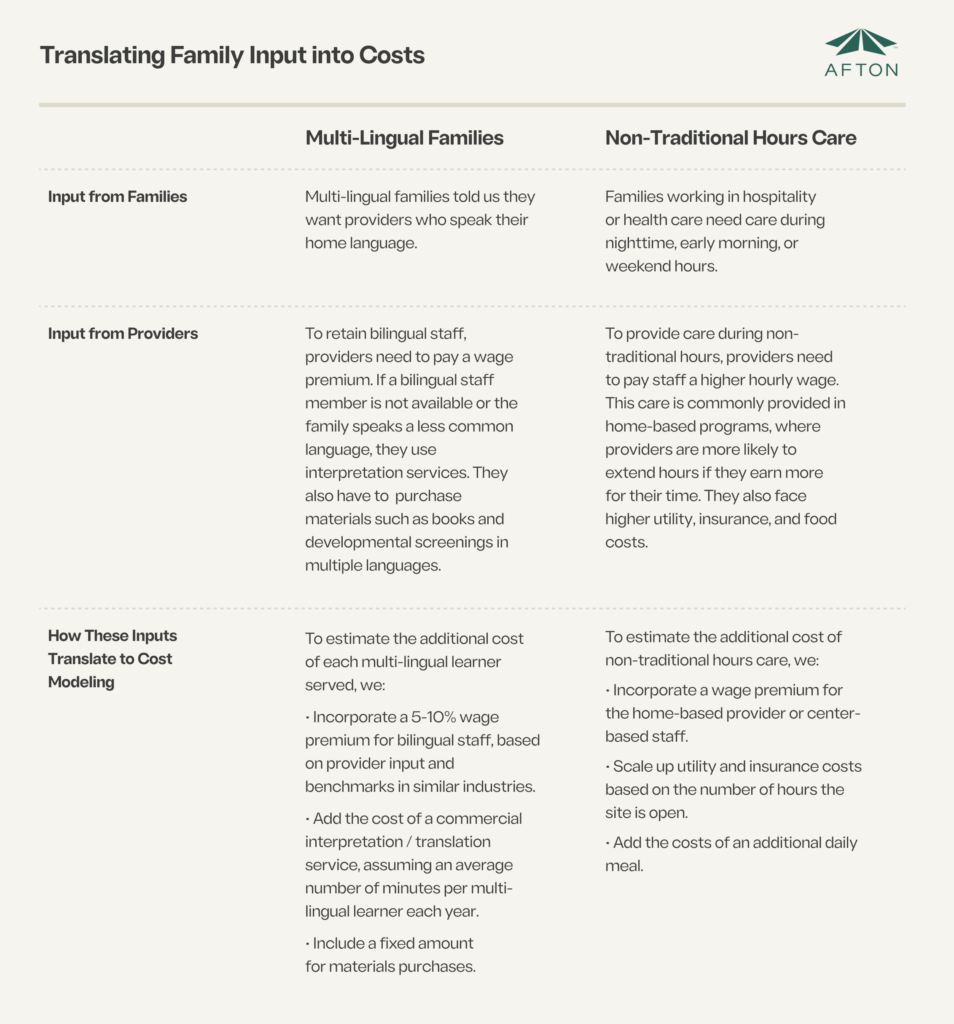
This is necessarily an imperfect process. All of these factors can and should be revised over time, as more information becomes available. This process is a starting place, creating a structure for translating families’ needs into funding policies that allows providers to meet them.
Planning engagement with the end in mind
A lot of great input gets stuck at the “So what?” stage. Families and providers share their challenges and what they want to see. Policy makers listen, but struggle to translate the input into concrete asks with a price tag attached.
As you prepare for your next CCDF plan, some questions to consider:
- Which voices have you not heard from directly? How does this overlap with the interests of your leadership (including department or cabinet leadership, elected officials, and advocates)?
- What would you need to know to put a price tag on their needs? This could include staffing, wage premiums, materials, training needs, and more.
- What is the best approach to engagement to hear from your priority voices at the level of detail you need? Surveys? Focus groups? Pushing into existing community meetings?
Asking these questions on the front end can help to ensure that the engagement process results in takeaways you can use to make the case for change – with dollars attached.
To learn more about our approach and how Afton can support your state, please reach out.
Related Insights

Infant & Early Childhood Mental Health (IECMH) – Strategies for Building a Statewide System
