


In 2025, state and local agencies across the country faced intensifying pressures. Tight budgets. Shifting school enrollment. Workforce shortages. Increasingly complex and uncertain policy environments.
And yet Afton’s client partners led with intention and clarity in service of their constituents. They made hard decisions. They improved opportunities for all.
Afton was proud to walk alongside them – designing, planning, and implementing ambitious policy and funding strategies through human-centered processes and rigorous data analytics.
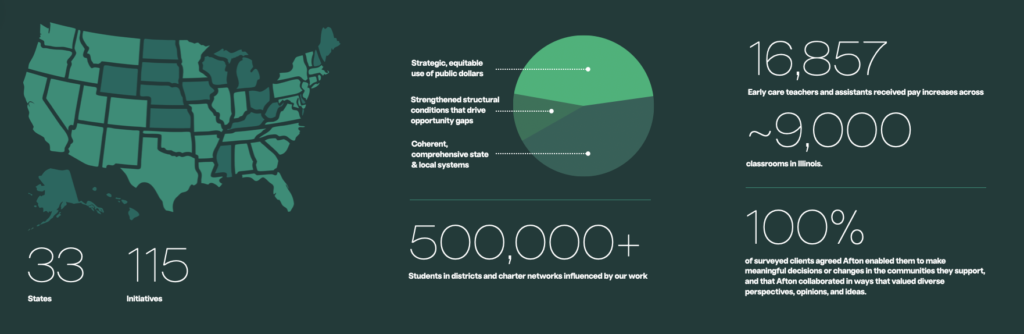
Across 33 states and localities, Afton’s work centered on three priorities:
- Strategic use of public dollars. We helped leaders assess, design, and implement funding policies and plans where they matter most.
- Coherent state and local systems. We supported leaders in building government systems that work for families and learners, incorporating data analytics, human-centered engagement, and policy design into agencies.
- Addressing conditions that lead to opportunity gaps. We provided insights & capacity to help partners to tackle root causes.
Certain themes held everywhere we worked: implementation matters as much as design. Workforce stability is a precursor to quality. Public leadership requires courage, clarity, a true love of mission, and trustworthiness at scale.
The pages that follow are a love letter to my talented, intentional, and fun colleagues at Afton and their impact in 2025. Their expertise is extraordinary. But in the public sector, expertise alone is never enough.
My colleagues understand real impact comes from a genuine commitment to mission and partnership. I see my colleagues showing up with humility, respect, and trust. And we see our client partners showing up the same way. Which created public impact that far exceeds even the smartest idea.
Carrie Stewart
Founding Partner & CEO
Afton’s Impact at a Glance
These numbers reflect more than activity. They represent systems strengthened and capacity built. Across states and sectors, we worked alongside leaders to align funding, clarify decision-making, and translate policy into durable implementation. The result isn’t just initiatives completed, but infrastructure that will continue serving communities into the future.
K-12: Helping Schools and States Navigate Financial Uncertainty
Rising student needs. Shifting enrollment. Uncertain revenues. Climbing costs.
Leaders across state agencies, districts, and charter networks are making high-stakes decisions in a volatile environment. This year, we helped them make strategic funding and policy decisions that hold up for current challenges and the resource-tight years ahead.
Turning State Policy into District Reality
Passing legislation is one thing. Making it work is another. Ambitious policy often stalls at the implementation stage. The same law lands very differently, depending on a district’s capacity and context.
Take mental health funding. Schools are increasingly expected to support student mental health as an important driver of academic success, while not typically being fully funded for it. We partnered with an advocacy organization to name that gap clearly and tie it to specific cost inputs.
In Rochester, MN, our work led to a new budget model that more effectively allocates resources in accordance with the district’s strategic plan. In Boston, district leaders are now putting into practice funding strategies we helped design, building more transparent and equitable resource allocation across their schools. Better policy by design. Stronger outcomes by implementation.
Project Highlight: Maryland
The Blueprint for Maryland’s Future applies to 24 county-level districts, including some of the nation’s largest systems and several in rural areas. They’ve been given the same policy, but have vastly different capacities to act.
Maryland’s Accountability and Implementation Board needed a partner who could advise at the state level while understanding what districts experience on the ground. Our team helped build implementation infrastructure so reform can happen on the ground.
After 18 months, the LEAs walked away with stronger budget processes, clearer systems for Minimum School Funding implementation, and experience navigating accountability requirements. And at the state level, the AIB gained a partner who could translate district-level challenges into policy-relevant insights. When implementation surfaced ambiguities, we helped develop solutions that kept the Blueprint on track.
Project Highlight: Massachusetts
In Massachusetts, we partnered with the Department of Elementary and Secondary Education to study how $3.4 billion in Student Opportunity Act and ESSER funds flowed through the system at the district and school level. The resulting report found that SOA funds reached the students the policy intended, and that the overlap with ESSER helped many districts sustain investments without the fiscal cliffs many feared. DESE now has a foundation to track how their funding reforms play out.
Helping Charter Networks Plan with Clarity
Charter school leaders know the reality: entrepreneurial spirit can sometimes be at odds with the headwinds. Enrollment is stagnant, costs keep climbing, future funding is uncertain, and student needs are rising.
Afton worked with 60+ charter school networks across 22 states to provide financial clarity in decision-making. We built scenario-based multi-year financial plans, created board-facing financial communications to tee up the right information for decisions, and pressure-tested growth plans before commitments got locked in.
We also coached school finance leaders, guided communities of practice, and trained boards and school leadership on Effective Financial Governance, Leading Through Financial Uncertainty, Long-Range Financial Planning, and Effective Financial Reporting.
Project Highlight: Alabama
I Dream Big and Independence Prep had something in common: neither had opened their doors yet. No students. No revenue. Just two leaders with a year of high-stakes decisions ahead of them.
We supported both schools in the window before students arrived, when the decisions that will shape a school’s finances for years get made. That meant facility strategy. Cash flow timing. Enrollment scenarios. Finance committee structure.
Both schools opened with facility strategies that matched their financial reality, operational costs mapped before contracts were signed, and boards equipped to govern, not just rubber-stamp.
Project Highlight: Texas
Vanguard Academy wanted to grow from 6,800 to 10,000 students via three new schools. The CFO had a number in mind to fund it, but needed more than instinct to bring it to the board with confidence.
We led a multi-month financial planning process that surfaced answers to pertinent questions in the decision making process: What does debt service coverage look like at different financing levels? What if enrollment comes in below plan? Which staffing assumptions don’t hold up at scale?
What we found was that central office positions had been growing proportionally with enrollment. We also uncovered a $2.3 million substitute line item that pointed to deeper data gaps between Finance and HR.
Vanguard is still growing. But now they’re growing with a single source of data truth, a staffing model built for scale, and a framework the team can use long after the engagement ended.
Early Care & Education: Building Systems That Work for Families
Early care and education systems have dramatically improved. But for many families, the day-to-day reality still feels fragmented. Hard to navigate, hard to afford, and hard to count on.
For ECE systems leaders, the challenge in 2025 wasn’t a lack of ideas, but the difficulty of translating policy into practice across complex, capacity-strained systems. Afton partnered with states to operationalize funding reforms, address workforce instability (including increasing pay), and strengthen the underlying infrastructure needed for programs to function more reliably for families and providers.
From Fragmented Funding to Coherent Systems
Early childhood funding often arrives through disconnected streams. Each with its own timelines and reporting requirements. Building coherence takes intentional effort.
In 2025, we did that work across a number of states. From redesigning how dollars flow, to building tools that help local leaders understand their own communities, the through line has been the same. Systems should adapt to families, not the other way around.
And the work is growing. We’re excited to be partnering with early childhood leaders in Arkansas and North Carolina as they build funding systems and policy frameworks that can actually deliver for young children and their families.
Project Highlight: Illinois
We were proud to help support the launch of the new Department of Early Childhood, designing funding mechanisms to direct resources equitably based on community needs and aligning program standards to support a comprehensive, simpler, and fairer ECE system for Illinois families, providers, workforce, and communities.
We were also proud to support the design and implementation of Illinois’ Smart Start Workforce Grants, which resulted in Illinois raising wages for early childhood workers, benefiting 16,857 teachers and caregivers across 8,878 classrooms.
And through our project with the Early Childhood Block Grant, we helped the state answer, “with limited funding, where does the next dollar have the most impact?” We built a methodology for equitable allocation that can persist year over year. In FY25, Illinois directed $9 million in quality dollars based on this approach, raising per-child funding minimums for 140 community-based providers.
Project Highlight: Louisiana
Leaders wanted to be ready to launch a formula for early childhood funding, while also making progress in the meantime. We built a statewide model showing where where gaps remain and what expansion would cost. When local leaders asked what this meant for their parishes specifically, we built a version they could use themselves. Now, through our partnership with Louisiana Policy Institute for Children, an interactive dashboard is available, helping local leaders to tell their own stories about community needs.
Workforce Development: Closing Gaps in Who Does the Work
Workforce gaps don’t just reflect shortages. They reflect barriers. Who gets recruited, trained, supported, and retained shapes who ultimately serves our communities. When entry points are narrow or advancement pathways unclear, systems strain. When those pathways are strengthened, communities benefit.
Building Workforce Systems That Actually Work
Workforce shortages don’t stay in one lane. They show up in schools that can’t find counselors or retain teachers, and employers who can’t find the people they need to grow.
The challenge is rarely a lack of will. It’s that the systems meant to develop, support, and connect workers are often disconnected from each other and their stakeholders.
In 2025, we worked across two very different workforce contexts to help partners do the hard work of building coherence: one focused on expanding who enters the behavioral health pipeline, and one focused on helping a public workforce system better understand the employers it exists to serve.
Different problems. The same underlying question: how do you build a system that actually works for the people in it?
Project Highlight: Illinois
Illinois could meet only 22% of its residents’ mental health needs. A 349:1 patient-to-provider ratio. Over a third of adults with co-occurring disorders receiving no treatment at all.
We helped the Illinois Behavioral Health Workforce Center build its first strategic plan, bringing together legislators, agencies, universities, and advocacy groups to identify 113 concrete actions across six goals.
They now have a blueprint addressing the full pipeline: early career pathways linking high schools to behavioral health careers, loan repayment in underserved regions, and Illinois’ first rural residency in psychiatry. Every goal has metrics reported directly to the legislators who control funding.
Project Highlight: Pennsylvania
MontcoWorks is a public resource designed to connect employers with qualified talent. The problem: most area employers didn’t know it existed, and some had misconceptions about who it served.
We worked with their team to figure out why, using employer focus groups, surveys, and a human-centered design process to build personas and map the real experience of trying to work with the system. What they found was that they couldn’t be all things to all employers, and trying to be was stretching their team thin.
The result was a clearer service model, reorganized personnel, and a new business services advisory council to own and carry the strategy forward.
Field Contributions: Adding to the Conversation
Afton’s impact extends beyond our consulting. Our team contributed to the broader field through research, writing, and public engagement.
Katie Reed published a series examining the tensions families experience navigating two different education systems before and after their children turn five. The education system asks families to stitch together fragmented pieces. Katie named what that feels like.
Two decades after Hurricane Katrina, Carrie Stewart reflected on her experience opening five charter schools in New Orleans in 40 days after the storm.
Abby McCartney presented her work on Early Intervention Cost Modeling at the Division for Early Childhood conference alongside Theresa Hawley. She also spoke at the Education Commission of the States alongside Libbie Sonnier on her ECE funding design work in Louisiana.
Ellen Johnson co-authored Talent Connections: Your Guide to Leveraging Chicago’s Workforce Investments, helping employers navigate the city’s workforce development ecosystem.
Sana Fatima, PhD, published Outcomes of a Trauma-Responsive Educational Approach at Scale and presented at the APPAM Fall Research Conference.
We’re proud of the curiosity and rigor our team brings to their client work. That energy shows up in the research they publish, the stages they present on, and the conversations they push forward. The work doesn’t stop at the deliverable.
Looking Ahead to 2026
The pressures that defined 2025 aren’t going away. Afton will keep showing up to find the opportunities in it all:
Strategic use of public dollars: helping leaders make resource decisions that hold up over time.
Coherent state and local systems: weaving connective tissue across stakeholders so when legislation and policy has the intended impact, benefiting communities and learners.
Addressing conditions that lead to opportunity gaps: tackling root causes, not just symptoms.
We expect to contribute to the evolving school choice landscape, increasing access to effective early childhood programs, and the strategic use of resources in an uncertain environment.
All in service of families, children, and communities.